
The need for forced-air cooling should be determined at an early stage in system design. It is important that the design plans for good airflow to heat-generating components and also allows adequate space and power for the cooling fan. The first stage in designing a forced-air cooling system is to estimate the required airflow. This depends on the heat generated within the enclosure and the maximum temperature rise permitted.
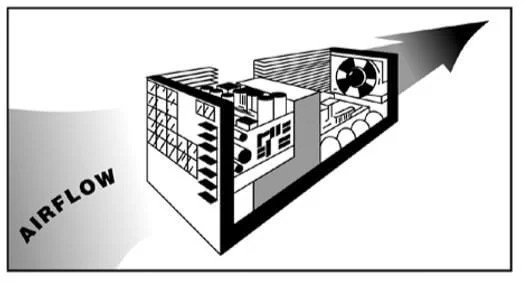
Enclosure with Cover Removed
The airflow required can be obtained either by calculation or from a graph. The equation for calculation is:

Q1 = Airflow required in m3/min
Q2 = Airflow required in cubic feet/min
H = Heat dissipated in watts
ΔT = Temperature rise above inlet temp °C
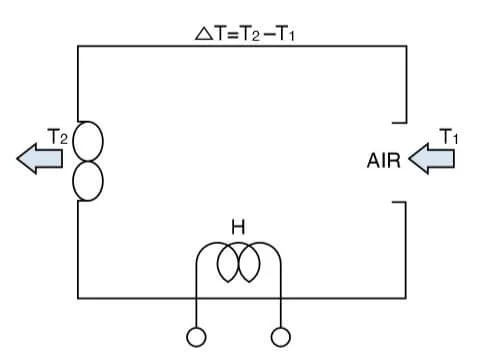
Airflow Calculation Visual
In the following graph, the vertical axis represents the heat to be removed and the horizontal axis represents the airflow; both axes are logarithmic. The sloping lines define the temperature rise in ˚C. To use the graph, find the sloping line that represents the permitted temperature rise. Then, find the point on this line that corresponds to the heat to be removed. The horizontal position of this point shows the airflow required.
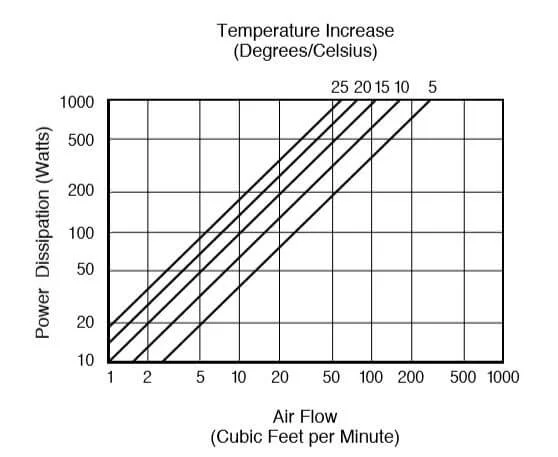
Power Dissipation vs. Airflow for Various Temperature Increases